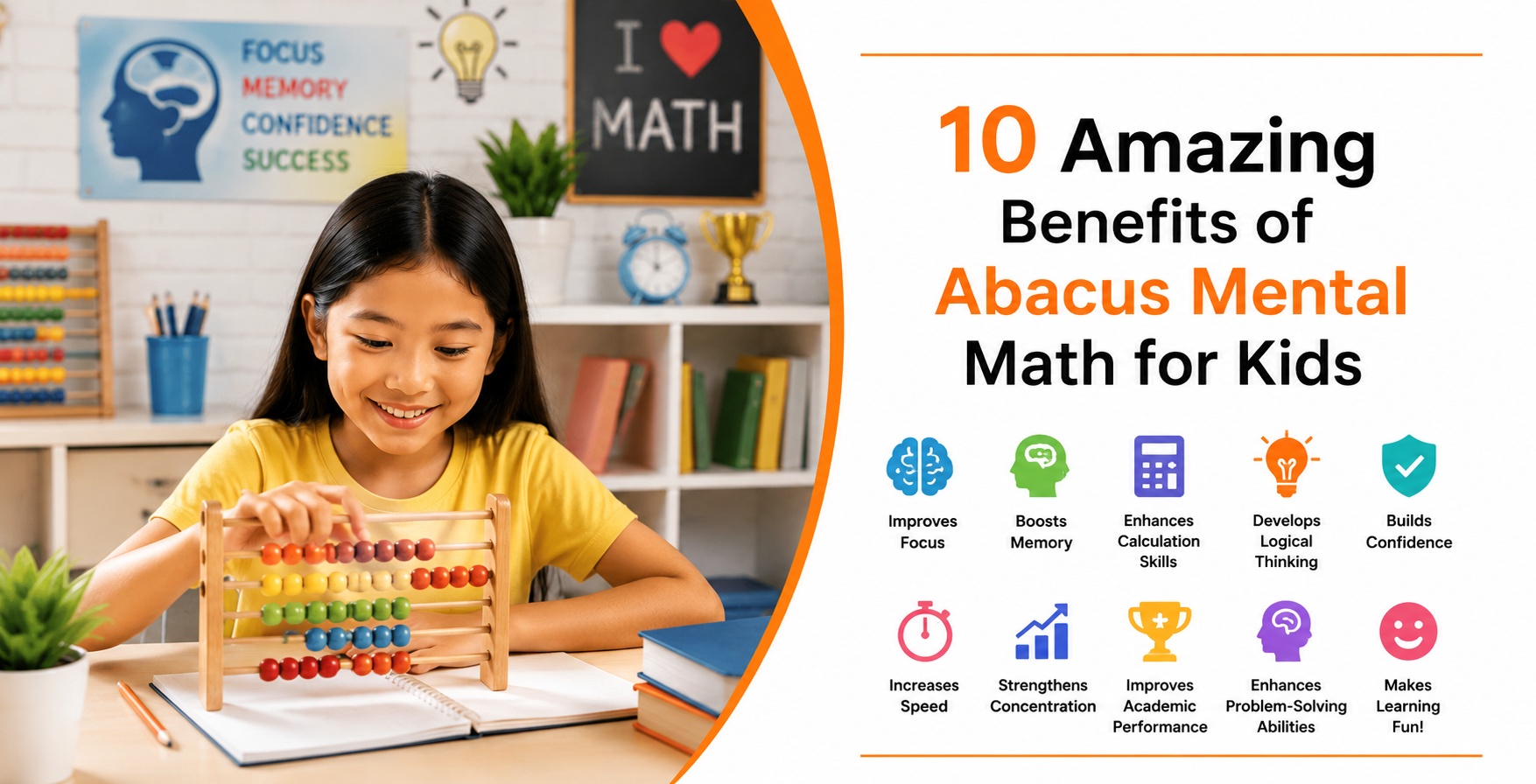
Kids today get pulled in many directions. Phones, tablets, and noise are everywhere. Sitting still and focusing on one task can feel hard for a young mind. This is where Abacus Mental Math helps a lot. It builds sharp focus. It builds fast calculation skills. It builds strong memory. All of this comes from simple daily practice.
A child does not use a calculator. A child does not count on fingers. Instead, a child learns to picture numbers in their mind. They use both sides of the brain to solve problems. This skill grows slowly at first. Then it speeds up once the basics click. A child who starts with simple bead counting can solve big number problems in their head within a year.
The following are the real benefits of abacus training for kids. We will look at better focus, real confidence with numbers, and why parents like this method.
1. Sharper Concentration
Kids today get pulled in many directions. Phones, tablets, and noise make it hard to focus. Abacus practice asks for something different. It asks a child to sit still. It asks a child to focus on one thing at a time.
While moving beads, a child pictures numbers in their head. They must block out everything else around them. This is not easy at first. But it gets easier with practice. A child who once got distracted after two minutes may now finish a full worksheet without looking up. Their attention span has grown stronger. Over a few months, most kids focus better in class. They focus better on homework too. Parents often say bedtime reading gets easier too.
2. Stronger Memory
As kids move past the beginner stage, they stop touching the abacus. They start picturing it in their head instead. This trains a special kind of memory. It is called visual memory.
A child who practices this gets better at holding numbers in their mind. They can hold pictures and steps in their mind too. Think of it like carrying a picture of the abacus in your head all day. This memory skill helps in other subjects too. Spelling words get easier to remember. Science steps get easier too. A child may even remember a phone number more easily. They may remember a shopping list too. Their mind gets used to holding many things at once.
3. Better Listening Skills
In abacus class, a teacher calls out numbers fast. Kids must solve them right away. This means a child must listen closely. They must react fast too.
This kind of listening practice helps outside of math class as well. Kids who train this way follow instructions better. They understand spoken words faster too. For example, a teacher may say, “Open your books, turn to page ten, and underline the title.” A child used to fast numbers can follow this easily. Teachers often see this improvement in other subjects too. Careful listening helps in every class, from history to group work.
4. Faster Mental Calculation
One of the best parts of mental math with an abacus is watching a child solve big problems in their head. They do not touch a calculator. They do not write anything down. What once took minutes with pen and paper now takes just seconds.
This speed is not magic. It comes from steady practice. The brain learns to picture bead movements fast. Many kids who train long enough solve rows of problems faster than adults with a calculator. A young student may finish twenty addition problems before a parent even finds their phone. This speed grows into multiplication and division too, as a child moves up in levels.
5. Less Fear of Math
Many kids feel nervous around numbers. This happens more if math has felt hard before. This fear can grow over time. Some kids start to think, “I am just bad at math.”
Abacus training helps stop this fear early. When a child solves a hard problem fast, something changes inside them. They stop feeling scared of numbers. They start feeling proud instead. A child who once hated math homework may now ask to do extra problems. They want to see how fast they can go. This new confidence shows up at home and school. It can help with other hard subjects too.
6. Whole Brain Development
Most schoolwork uses only one part of the brain. Reading, writing, and basic math use the left side. This side handles logic and language. The right side of the brain handles imagination and pictures. Regular school often leaves this side out.
Abacus training works both sides at once. The left brain handles the number rules. The right brain pictures the abacus and its beads. Training both sides builds a balanced brain. This is not just good at one thing. This balance can show up in fun ways. A child may get better at drawing. A child may get better at building with blocks. A child may explain ideas better out loud too.
7. Better Problem-Solving
Every abacus problem is like a small puzzle. A child must find the fastest way to move the beads. This gets harder as lessons move forward.
This habit of breaking a big problem into small steps helps outside of math too. It helps with word problems. It helps with science projects. It even helps with planning a homework schedule. A child may use this same thinking to pack a school bag. They may use it to split chores with a sibling. They may use it to solve a puzzle at home. Kids trained this way face new problems with curiosity, not stress. They are used to breaking big things into small pieces.
8. Better Grades Across Subjects
Abacus math lessons don’t just help in math class. Kids pick up focus, memory, and listening skills all together, and those skills spill over into everything else they do at school.
Take a kid who used to squirm through reading time. After a few months of abacus practice, sitting still gets easier. Spelling words that used to slip away now stick better too, thanks to the visual memory these lessons build. Report cards often tell the story best. Grades climb not just in math but in science, language arts, even art class. And teachers notice something else: a kid who seems steadier, calmer, more ready to actually learn, all day long, not just when numbers are on the table.
9. Help With Timed Tests
Timed tests can feel stressful for any child. But kids trained in abacus handle them better. They can calculate fast in their head. This saves time on number questions. It leaves more time for harder questions too.
This speed also comes with fewer mistakes. Abacus practice trains kids to be careful, not just fast. One wrong bead move gives the wrong answer. So kids learn to check their work without slowing down too much. This habit helps during any test with a time limit. A child used to catching small errors in abacus class often checks their school test work more carefully too. This can turn a good grade into a great one.
10. Real Life Skills
Beyond school and grades, abacus training builds three big habits. These are speed, accuracy, and discipline. These habits help kids for their whole life.
Speed means you think fast. You answer fast too. But you don’t rush so much that you make mistakes. Accuracy means you get it right the first time. You don’t guess. Abacus math has no room for guessing at all. Discipline is different. It comes from practicing every single day. Some days feel slow. Some days feel boring. You practice anyway.
Abacus math leaves no room for guessing. Discipline comes from practicing regularly. This includes days when progress feels slow or boring. For example, a child who does ten minutes of practice every day, even on boring days, learns a lesson about staying consistent. This lesson goes far beyond the abacus. These three habits shape how a child does schoolwork. They shape how a child handles hobbies, sports, and challenges too. This stays true for years to come.
Getting Started With Abacus Training
Kids as young as four can start learning abacus and mental math. Most programs grow along with a child’s age and skill level. Classes start with simple bead movements. Then they slowly build up to full mental math, without touching the abacus at all.
Small class sizes help a lot at this stage. When a child gets one-on-one attention, they move at their own pace. They do not feel rushed or left behind. A small group of four to six students lets a teacher notice if one child needs extra help. The teacher can also see if another child is ready to move ahead. Weekly practice, even for just an hour or two, is often enough. Kids can see steady progress over a school year this way.
Conclusion
Parents thinking about signing up their child should look for a clear step-by-step program. A good program does not just teach fast calculation. It builds each skill one step at a time. This way, a child’s confidence grows, along with their speed. Each new level feels like a small next step, not a big jump.
Ready to give your child this head start with numbers? Get abacus classes built around small groups and steady, year-long progress.