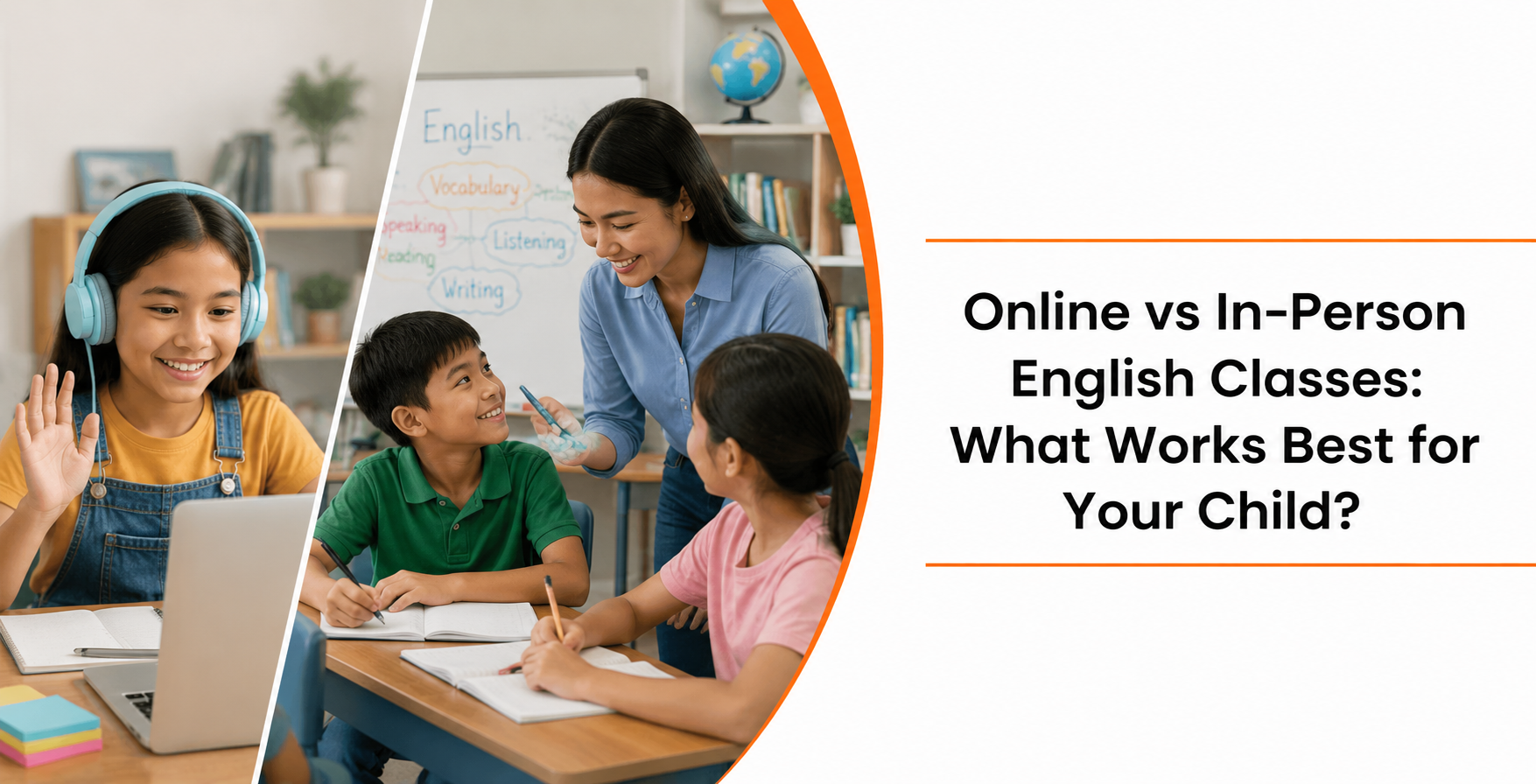
Every parent hits this decision at some point – usually while watching their child struggle through a homework assignment or stumble through a presentation at school. The question isn’t whether extra English support would help. It usually would. The question is which format actually delivers that help in a way that works for this particular child, with this particular schedule, in this particular family’s life. English classes online versus a traditional classroom aren’t interchangeable options with identical outcomes. They’re genuinely different experiences, and the right one depends on factors most comparison articles gloss over.
Why English Learning Matters More Than Ever
English plays an important role in school, future careers, and everyday communication. The points below explain why learning English has become more important than ever for children today :
Strong Communication Skills Support Academic Success
English isn’t just one subject among many, it runs through all of them. A student who can read instructions carefully, write a coherent argument, and express ideas clearly has an advantage in history, science, maths, and everything else. The ones who struggle to articulate their thinking often know more than their grades suggest. The language barrier holds them back across the board, not just in English class.
English Confidence Impacts Future Opportunities
The returns on good communication show up everywhere: a job interview that goes differently than expected, a university application that reads with genuine confidence, a professional relationship that builds because someone could articulate themselves clearly. The people who never quite got there often can’t point to exactly where it cost them, but it does. Children who build genuine confidence in speaking and writing early carry that advantage into situations where it counts far more than exam results.
Reading, Writing, and Speaking Skills Develop Together
These three things feed each other in ways that make isolated improvement difficult. Reading builds vocabulary that improves writing. Writing solidifies grammar that makes speaking cleaner. Speaking builds the confidence that makes reading aloud and presenting feel manageable. A programme that treats all three as connected, rather than separate boxes to tick, tends to produce better results.
Understanding Online English Classes
Many families are choosing online English classes because they fit easily into busy schedules and provide access to quality instruction from anywhere. The sections below explore how these classes work and the benefits they offer.
How Online English Classes Work
Most platforms run live video sessions where students interact directly with a teacher in real time – not pre-recorded lessons watched alone, but actual instruction with feedback, questions, and back-and-forth conversation. Sessions might be one-on-one, small groups, or a mix of both. Interactive whiteboards, shared documents and digital exercises keep things moving rather than leaving students, staring passively at a screen.
Skills Students Can Improve Online
Reading comprehension, writing techniques, grammar accuracy, vocabulary development, and speaking confidence can all be developed through well-structured virtual instruction. The format doesn’t limit what gets taught, it changes how it gets delivered. Many families choose Online English tutoring specifically because one-on-one attention allows a teacher to target exactly what a particular child needs rather than teaching in the middle of a class.
In-Person English Classes
In-person English classes offer a traditional learning experience where students learn directly from teachers in a classroom setting. This approach encourages face-to-face interaction, immediate feedback, and active participation in lessons and group activities.
Traditional Classroom Environment
A physical classroom has a rhythm to it that some children genuinely need. The same room, the same time, the same faces routine creates a kind of accountability that’s harder to manufacture at home. For children who drift without structure, that consistency matters.
Face-to-Face Teacher Interaction
Some kids respond to a teacher’s physical presence in a way they simply don’t to a screen. The ability to read body language, to catch a look of confusion before it becomes a problem, to redirect attention with a glance these are things that happen naturally in a room and require more deliberate effort online.
Group Learning Experience
Classroom learning puts children in contact with peers who think differently, express things differently, and ask questions the individual student wouldn’t have thought to ask. That exposure has its own educational value, separate from anything a teacher explicitly delivers.
Classroom-Based Activities
Reading circles, writing workshops, group presentations, collaborative exercises – the classroom format supports activities that are difficult to replicate online, and for certain types of learners, these activities are where the real learning happens.
Online vs In-Person English Classes
Both formats work. Neither works for everyone. The table below captures the practical differences honestly:
| Factor | Online English Classes | In-Person English Classes |
| Flexibility | High | Limited |
| Personalized Attention | Excellent | Moderate |
| Travel Time | None | Required |
| Classroom Interaction | Moderate | High |
| Learning Pace | Customized | Fixed |
| Convenience | Excellent | Moderate |
| Technology Requirement | Required | Not Required |
| Cost | Often Lower | Often Higher |
Benefits of Online English Classes for Children
Online English classes give children the flexibility to learn from any location while receiving focused support based on their individual needs. They can help improve language skills in a comfortable environment that encourages active participation and consistent progress.
Flexible Scheduling
Families with packed schedules – sport commitments, sibling activities, parents working irregular hours – often find that fitting regular lessons around everything else is the first barrier. Removing the commute and the fixed time slot makes consistent attendance genuinely achievable rather than aspirational.
Personalized Learning Plans
A student who needs focused work on written grammar gets that. One who needs to build spoken confidence gets something different. English Classes Online that operate on individualised plans don’t make every child sit through content they’ve already mastered while waiting for the class to catch up.
Greater Access to Expert Tutors
Geography used to determine quality. A family in a town without specialist English tutors had limited options. Virtual learning removes that constraint entirely – the best available instructor for a specific need is accessible regardless of where either party is located.
Comfortable Learning Environment
Anxiety about being watched, judged, or embarrassed in front of classmates holds a lot of children back from participating fully. At home, that particular pressure disappears. Many children who are reluctant contributors in classroom settings become noticeably more engaged when they’re learning in a space where they feel safe.
Better Parent Visibility
Parents sitting nearby during a virtual lesson have a clearer picture of what’s being covered, how their child is responding, and where the gaps are. That visibility feeds directly into the support that happens between sessions.
Benefits of In-Person English Classes
In-person English classes provide a structured learning environment where students can interact directly with teachers and classmates. This face-to-face setting helps many children stay engaged, participate actively, and develop strong communication skills.
Face-to-Face Social Interaction
For children who are naturally social, or who don’t get much peer interaction outside school, the classroom environment provides something virtual learning doesn’t – the experience of navigating a group, listening to others, and contributing to something collective. These aren’t soft extras. They’re communication skills being practiced in real conditions.
Structured Classroom Environment
Some students produce their best work inside clearly defined routines. Knowing that class starts at a fixed time, in a fixed place, with a predictable structure, removes the negotiation that can derail home-based learning.
Fewer Digital Distractions
A browser tab away from a game, a notification arriving mid-lesson, a sibling appearing in the background – online learning asks children to manage distractions that simply aren’t present in a physical classroom. For students who struggle with this, the classroom environment does the management for them.
Group Communication Practice
Discussions, presentations, and collaborative tasks put children in situations where they have to communicate under mild pressure – not high-stakes pressure, but enough to make the practice meaningful. This kind of repeated, low-risk public communication builds confidence in ways that private tutoring sessions don’t always replicate.
Which Students Benefit Most from In-Person English Classes?
Highly social learners who gain energy from being around peers, rather than losing it. Children who genuinely need someone physically present to stay on task. Younger students who are still building the self-regulation skills that independent learning requires. Students whose home environment makes focused online learning difficult regardless of motivation.
Online vs In-Person English Classes by Grade Level
The learning needs of children often change as they grow, which means the most suitable class format can vary by age and grade level. Understanding how each option supports different stages of learning can help parents make a more informed decision.
Elementary School Students (K–5)
Young children need engagement and variety to hold attention. Virtual lessons can deliver both when designed properly, but require active parental involvement to keep the structure in place. The format works – it just asks more of the adults at home.
Middle School Students (Grades 6–8)
This age group is adaptable. Students who value independence and flexibility often take to Online English tutoring easily. Those who are more social or who struggle with self-direction, may get more from classroom learning. There’s no universal answer here – individual personality matters more than grade level.
High School Students (Grades 9–12)
Older students are generally capable of managing their own learning environment, and making consistent independent choices. Virtual programmes suit the competing demands of this stage – academics, extracurriculars, part-time work, exam preparation. Students targeting competitive universities or working through SAT English Prep Classes often find the focused, customisable nature of online instruction particularly effective.
Key Factors Parents Should Consider Before Choosing
Child’s Learning Personality
A child who thrives on social energy and withers without it is a different case from one who does their best work alone. Neither is wrong. But putting the first in a virtual one-on-one session and the second in a noisy classroom and expecting identical results ignores what you already know about your child.
Academic Goals
Exam preparation, conversational confidence, writing improvement, grammar correction – these require different approaches. Know what you’re trying to fix before choosing the environment.
Schedule Flexibility
Consistent attendance matters more than format. A brilliant classroom programme that gets missed half the time because of scheduling conflicts will produce worse results than a decent online programme that actually happens every week.
Budget Considerations
Virtual options tend to cost less because they eliminate transport, facilities, and the overhead that comes with physical premises. The quality of instruction varies across both formats – price is not a reliable indicator of outcome in either direction.
Technology Access
A stable internet connection and a device with a functioning camera and microphone are the minimum requirements. These aren’t guarantees in every household, and it’s worth confirming the setup works before committing to a virtual programme.
Common Myths About Online English Classes
As online education continues to grow, several misunderstandings about virtual learning still exist. The following myths are often heard by parents when considering online English classes for their children.
Myth 1: Online Classes Are Less Effective
Effectiveness comes from the quality of the teaching and the engagement of the student, not from whether the teacher is physically in the room. Research and practical experience both support this. A weak teacher in a classroom produces worse outcomes than a strong teacher on a screen.
Myth 2: Students Cannot Stay Engaged Online
This one depends almost entirely on how the lessons are designed and delivered. Passive video watching produces disengaged students. Live, interactive, back-and-forth sessions with a skilled teacher produce something quite different.
Myth 3: Online Learning Lacks Personal Interaction
Many students receive more individual attention in a one-on-one virtual session than they ever get in a classroom of twenty-five. The interaction is different in character – it’s not social in the same way – but it’s often more focused and more responsive to the individual student’s needs.
Which Option Is Best for Your Child?
There isn’t a clean universal answer, and anyone who offers one is oversimplifying. Virtual learning tends to deliver better results for families who need flexibility, children who work well independently, and students requiring focused instruction targeting specific gaps. Traditional classrooms tend to serve children who genuinely need social learning, structured routine, and direct physical presence from a teacher.
For many families, the deciding factor ends up being practical rather than philosophical – schedule, budget, location, and the child’s honest reaction to each format. SAT English prep classes, conversational practice, academic writing support – all of these can succeed in either setting when the programme is good and the student is engaged.
If English classes online are on the table for your child, the questions worth spending time on are: Does this child manage independent work reasonably well? Is the home environment conducive to focused learning? Does the programme run live interactive sessions rather than pre-recorded content? Does the teaching approach match what this particular child actually needs? Answer those honestly and the decision tends to become clearer.