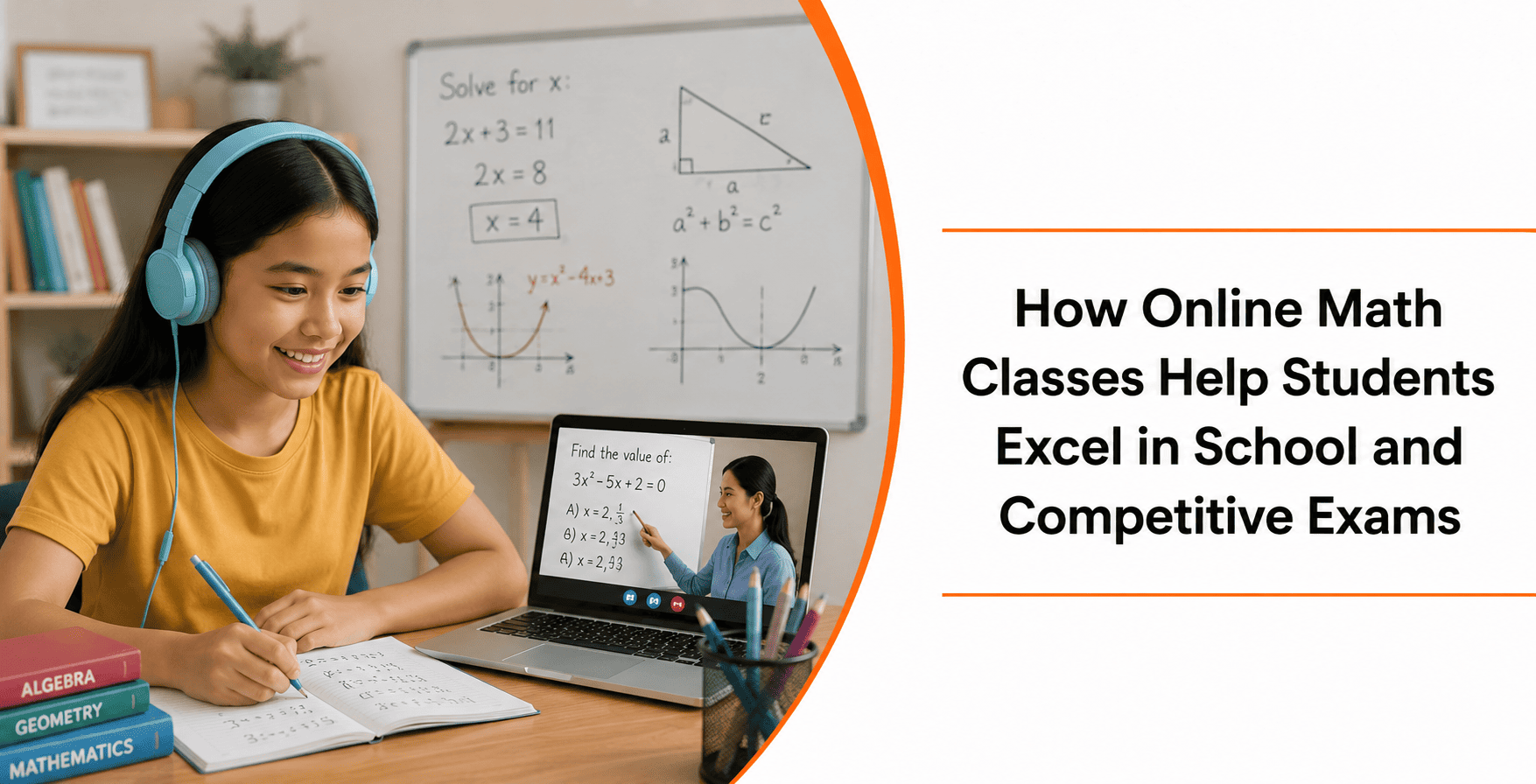
Math is one of those subjects that punishes gaps. Miss something in year six and you’ll feel it in year eight. By the time most students realise they’re behind, they’re already two topics deep into something that assumes knowledge they don’t have. Teachers in a class of thirty can’t always catch this early enough to fix it. That’s the problem Online Math Classes were built to solve – and for a lot of students, they’re doing exactly that.
Why Are Online Math Classes Becoming a Preferred Learning Option?
School moves at one pace. That pace works for some students and not for others, and there’s very little a classroom teacher can do about it when they’ve got twenty-five other kids to get through the same lesson.
Online learning doesn’t have that constraint. A student who didn’t follow something the first time can go back. A student who’s ready to move ahead can. Support gets shaped around the person doing the learning rather than the average of the class. And for families in areas where decent tutors are hard to find, the location barrier simply disappears. The quality of instruction a student in a small town can access online is the same as what’s available to someone in the middle of a city.
How Do Online Math Classes Improve Conceptual Understanding?
Most students who struggle with math aren’t struggling with the work itself – they’re struggling because they’ve been taught to memorise methods without understanding what those methods actually do. That approach holds up until the exam puts a question in an unfamiliar format, and then it falls apart completely.
The better Online Math Classes teach the reasoning, not just the steps. Why does this method work? What’s actually happening here? When a student understands that, they can adapt. They’re not stuck if the question looks different from the practice paper – they know what they’re doing well enough to figure it out. That’s what exams are testing, and that’s what actually prepares students to pass them.
The Growing Importance of Online Math Tutoring for Individual Success
Every student has a different weak spot. One kid breezes through algebra and hits a wall with geometry. Another handles numbers fine until word problems show up and suddenly nothing makes sense. A classroom lesson covers the topic for everyone and moves on – it can’t stop and fix one student’s specific gap while the rest of the class waits.
Online Math Tutoring can. A tutor working with one student can see exactly where the understanding breaks down, work on that specific thing, and not move on until it’s actually understood. Doubts get resolved in the session. Progress gets tracked as it happens, not discovered at the end of term when there’s no time left to do anything about it.
Students improve faster this way – not because the tutor is somehow better than a classroom teacher, but because the teaching is aimed precisely at what that particular student needs rather than at the class in general.
Online Math Classes vs Traditional Learning
Choosing between online and traditional learning is a common concern for parents and students. Both methods offer advantages, but online learning provides several unique benefits that support modern educational needs.
| Feature | Online Math Classes | Traditional Classroom |
|---|---|---|
| Learning Pace | Personalized | Fixed |
| Flexibility | High | Limited |
| Access to Lesson Recordings | Available | Not Available |
| One-on-One Support | Easily Accessible | Limited |
| Progress Monitoring | Detailed Analytics | Periodic Reports |
| Learning Resources | Extensive Digital Tools | Textbook-Based |
| Travel Requirement | None | Required |
| Exam Preparation | Customized | Generalized |
How Private Math Tutoring Helps Students Prepare for Competitive Exams
Knowing the material and performing well in a timed, high-pressure exam are two different things. Plenty of students understand their subject reasonably well and still underperform on test day because they haven’t prepared for the specific conditions of the exam itself.
Private Math Tutoring for exam preparation addresses this directly. Study plans built around the exam format. Problem-solving approaches that work, under time pressure. Mock assessments that replicate the real experience closely enough that the actual exam doesn’t feel unfamiliar. Recurring mistakes identified and corrected before they cost real marks.
Students who prepare this way don’t just know the content – they know how to perform when it counts, which is a different and very learnable skill.
Why Consistent Practice Matters
The belief that some people are naturally good at math and others simply aren’t causes more damage than almost any other idea in education. It gives struggling students a reason to stop trying and gives parents a reason to accept poor results. The evidence doesn’t support it. Practice matters far more than aptitude, and students who put in consistent work improve – full stop.
Online platforms make that consistency easier to maintain. The exercises are there when the student is ready to do them. Lessons can be revisited without any awkwardness. A concept that didn’t land the first time can be approached again, and again if necessary, until it does. Over months, that regular engagement builds something that cramming before an exam never can – an actual understanding of how mathematical thinking works.
How Math STAAR Practice Test Preparation Improves Student Performance
For students sitting Texas state assessments, working through a math staar practice test regularly is one of the most straightforward ways to improve results. The format becomes familiar. The question types stop being surprising. Time management improves because students learn from experience how long different questions actually take rather than guessing on the day.
Practice tests also tell you exactly where the marks are being lost, which is more useful than general revision. Instead of going back over everything, students can focus on the specific areas where they’re dropping points. By the time the real assessment arrives, it genuinely feels like something they’ve done before – because they have, repeatedly.
How Technology Is Transforming Mathematics Education
The tools available in online learning today – interactive whiteboards, adaptive exercises, instant feedback, digital worksheets – make the experience genuinely more engaging than sitting with a textbook and hoping things click. Students aren’t passively listening. They’re working through problems, getting immediate feedback and adjusting, in real time.
The data these platforms generate is useful, too. Tutors and parents can see exactly where a student stands, which topics are improving, and where more work is needed. That means teaching decisions get made on actual evidence rather than impression, and students don’t spend time revising things they already know while neglecting things they don’t.
What Additional Skills Do Students Develop Through Online Learning?
Academic results are the obvious goal but not the only thing that improves. Math done properly builds persistence – the habit of working through something that’s genuinely hard rather than giving up when it gets uncomfortable. Students in structured online programmes also develop time management because they’re juggling sessions alongside school, sport, and everything else.
The confidence that comes from mastering something difficult is harder to measure but probably more valuable long term. Students who’ve worked through tough material and come out the other side tend to approach new challenges differently – less convinced they can’t do it before they’ve tried, more willing to sit with a problem until it gives.
Conclusion
Online Math Classes work because they fix the specific things that traditional classroom learning can’t always address – individual gaps, fixed pace, limited one-on-one time, and exam preparation that’s too general to be of much use. Online Math Tutoring and Private Math Tutoring give students the targeted support that actually moves the needle. Regular work with a math staar practice test builds the kind of familiarity that takes the edge off test day.
Get structured, individual support for students who need more than the classroom is giving them – focused teaching aimed at real results rather than just keeping up.